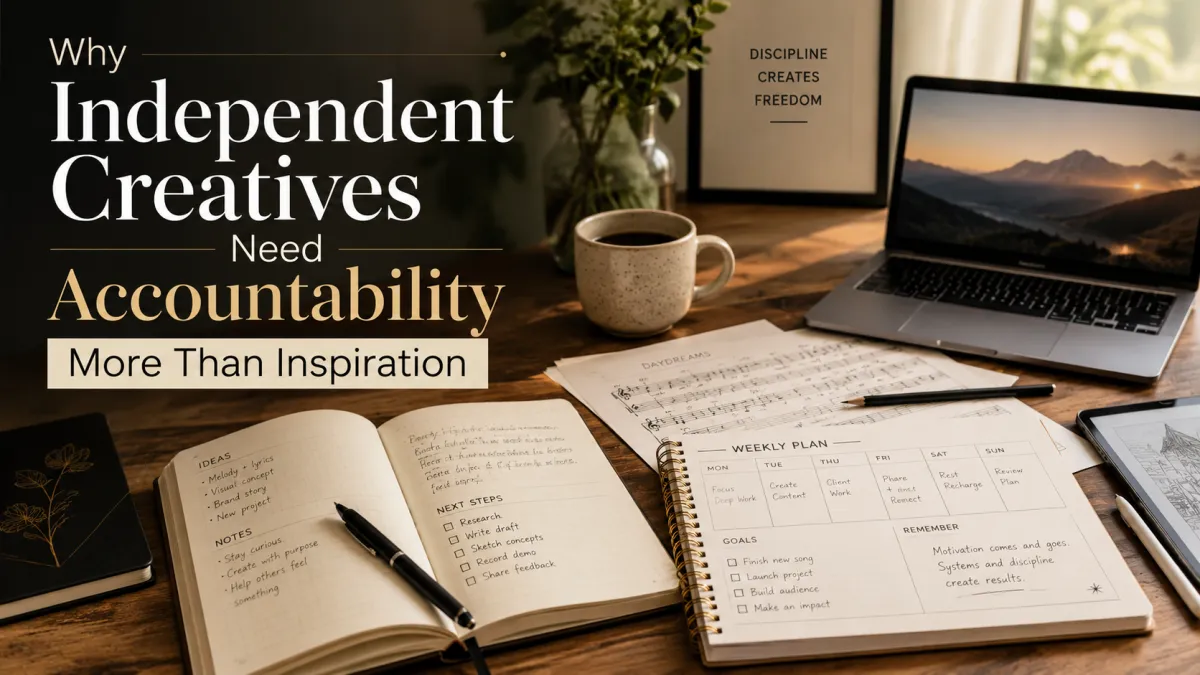
Why Independent Creatives Need Accountability More Than Inspiration
Independent Creatives are usually overflowing with ideas.
That's one of the beautiful things about creative people. They see possibilities everywhere. A sentence becomes a book. A melody becomes a song. A conversation becomes a podcast. A personal breakthrough becomes a course. A problem they solved for themselves becomes something they could teach, share, publish, perform, sell, or build into a business.
Many independent creatives are walking libraries of unrealized possibilities. They have notebooks filled with half-written songs, unfinished essays, book outlines, course ideas, paintings, business concepts, podcast titles, launch plans, workshop ideas, and someday projects. Their phones are full of voice memos. Their desks are covered with fragments of Post-it notes and random papers. Their hard drive holds drafts from three different versions of who they were becoming.
There isn't a lack of creativity. It's the exact opposite.
The Creative World Is Overflowing with Ideas
As long as there are creative people, there will be more ideas than any one person can complete in a lifetime. That's part of the gift of being creative. A creative mind continually makes connections. It keeps noticing patterns. It keeps imagining what could exist. It keeps receiving the spark of possibility from books, music, movies, pain, frustration, curiosity, and just the ordinary aspects of daily life.
That inspiration is real, and it matters. Inspiration is often the doorway into what becomes meaningful work.
The challenge begins with what happens next.
Once the first spark arrives, independent creatives are faced with a very different kind of work. An idea that was sparked must be chosen. The project must be defined. That path must be reverse-engineered. Time must be allocated and protected. Distractions must be managed. The work must be completed. Then, once the work is finished, it has to be shared, talked about, offered, sold, improved, and supported long enough to reach the people it is meant to reach.
This is when many creatives begin to feel overwhelmed.
At first, it's exciting. The beginning is full of energy. The vision is alive. The creative can see the finished work in their imagination, and for a while, that vision supplies motivation that creates momentum. But as the project becomes real, it also becomes more complex. Decisions multiply. Doubt appears. New ideas begin competing for attention. The creator realizes that this is work, and finishing the work is only part of the journey. Then a deeper question begins to emerge: "Once I'm done, how will anyone find my completed work?"
That singular question is when many creative projects slow down.
Independent creatives often have a complicated relationship with the marketplace. They may love creating the work, but feel uncomfortable promoting the work. They may believe deeply in the project, but feel hope that if the work is good enough, it will be miraculously discovered, shared, and carried forward by other people.
Sometimes, that actually happens. Most of the time...it does not.
Brilliant work deserves more than quiet hope. It deserves a path into the world.
This is one of the central challenges for independent creatives: they're rich in inspiration, and under-supported in follow-through. They can begin. They can imagine. They can learn. They can refine. However, without a system, the creative life can become a cycle of starting, stopping, researching, reworking, rebranding, doubting, and starting again.
A new idea arrives before the last idea has been completed. A new strategy appears before the previous strategy has been tested. A new course promises a missing piece. A new platform looks more promising. A new business model feels cleaner, faster, or more aligned. The creative mind moves toward the new spark, and the older project quietly begins to die.
This is "Shiny Object" interference, and it's dangerous for creatives.
These constant idea sparks are abundant and are a normal part of a creative mind. But without a strong structure to contain these new ideas, permanent derailment can prevent them from completing their creative dreams. With so many sparks, choosing one idea can feel restrictive. When every idea feels fresh and alive, finishing one project can feel like abandoning ten others. Additionally, when a schedule appears, the creative can feel boxed in. Finally, when asked to be accountable, the creative can feel exposed.
That's why the scarce resource isn't inspiration, it's...Follow-Through.
Follow-through is harder than inspiration because it requires a different kind of energy. Inspiration is often emotional. Follow-through is relational, structural, and behavioral. It asks the creative to make decisions. It asks them to do the work when the feeling or inspiration has changed. It asks them to keep promises to themselves. It asks them to measure progress. It asks them to share imperfectly. It asks them to finish something specific while dozens of other possibilities are still calling for attention.
Many creatives want freedom, and rightly so. Creative freedom is essential. But creative freedom without structure can become creative exhaustion. Every day becomes a new negotiation. Every project competes with every other project. Every unfinished idea carries emotional weight. The creator is free to do anything, which often means they struggle to complete the thing that matters most.
A clear system doesn't kill creativity. A clear system protects creativity.
A system gives the creative mind a place to put its energy. It helps the creator choose one Primary Quest for a season. It turns the vague desire to "build something" into a defined project with a path and measurable next steps. It makes room for new ideas without letting every new one hijack the current mission. It gives the creator a way to say, "This new idea may matter, but it doesn't belong in this creative cycle."
That alone is powerful. But even systems aren't always enough.
Many creatives have systems. They have planners, templates, courses, dashboards, calendars, notebooks, apps, frameworks, and lists. They know what they should do. They may even know exactly what would move their project forward. Therefore, knowledge alone doesn't automatically create action. And a framework without accountability can become one more beautiful thing the Creative studies, but never lives.
This is why accountability is so essential.
Accountability brings the system into the relationship. It creates a rhythm where the creative is invited to speak clearly about what they're choosing, what they're building, what they're going to finish, what they're sharing, and what they're learning. It turns private intention into visible commitment. It gives the creative a place to return when the project becomes hard, boring, complicated, or emotionally uncomfortable.
The best accountability isn't harsh or mean. It's there to be a mirror, an impartial reflection. Healthy accountability is a supportive container for creative momentum.
It asks honest questions. What are you focused on this week? Did you accomplish your tasks from last week? What was good? What got in the way? What needs to change? Where are you avoiding visibility? How are you overcomplicating the path? What is preventing you from taking the next step?
These are important questions. They matter because independent creatives often work alone. They may have an audience, students, clients, customers, or followers, but the actual act of creating can still feel isolating. They're carrying the vision, the doubt, the planning, the production, the marketing, the learning, the executing, and the emotional weight of the project inside themselves.
Independence is fantastic. Isolation is costly.
Accountability allows independent creatives to remain independent without being unsupported. It gives them a rhythm of return. It gives them a place to be noticed when they're drifting off course. It's a place to celebrate progress before the outside world notices. It helps them keep moving when the marketplace is quiet, the launch is slow, or the first attempt doesn't produce the result they hoped for.
This matters even more after a project is finished.
Many creatives imagine that finishing the work is the finish line. The book is written. The album is recorded. The paintings are completed. The course is built. The website is live. The community is open.
But finishing the work is just the beginning of the next phase. The work needs to be amplified.
Unfortunately, this is where many creatives struggle most. They don't want to sound pushy. They don't want to bother anyone. They don't want to be a "salesperson." Somewhere along the way, they may have adopted the idea that selling is somehow wrong. That it's beneath the purity of the creative act. They may feel that talking about their work too much makes them less authentic. They hope the work speaks for itself.
However, the work can only speak for itself when people have the opportunity to encounter it. And that is why creatives need a new relationship with "selling."
Selling doesn't have to mean manipulation. There doesn't need to be pressure. It doesn't need to pretend something is more valuable than it is. Selling, at its best, is the act of helping the right people find something that may genuinely serve them.
A book can change the way someone sees their life. A song can help someone feel less alone. A painting can bring beauty into a home. A course can help someone develop a skill. A coaching program can help someone move through a meaningful transition. A community can help someone stay connected to their own momentum.
When a creative believes in the value of their work, sharing it becomes an act of service.
This is the reframe many independent creatives need. Amplification is not an interruption. It's part of the creative responsibility. The creator made something for someone. The next step is helping someone find it.
Accountability helps here, too. It helps the creative move beyond the emotional resistance to visibility. It helps them make sharing part of the commitment rather than a separate dramatic event. It helps them talk about the work confidently, not desperately. It helps them learn from feedback, refine their message, and keep inviting people into the value they've created.
This is the gap CREATE is designed to address.
CREATE: Focus. Finish. Grow. is built for independent creatives who are ready for more than just inspiration. It's for the writer, musician, artist, educator, course creator, digital creator, or creative entrepreneur who has meaningful work to complete and wants a structure for turning that work into momentum.
The CREATE Operating System gives the process a clear path:
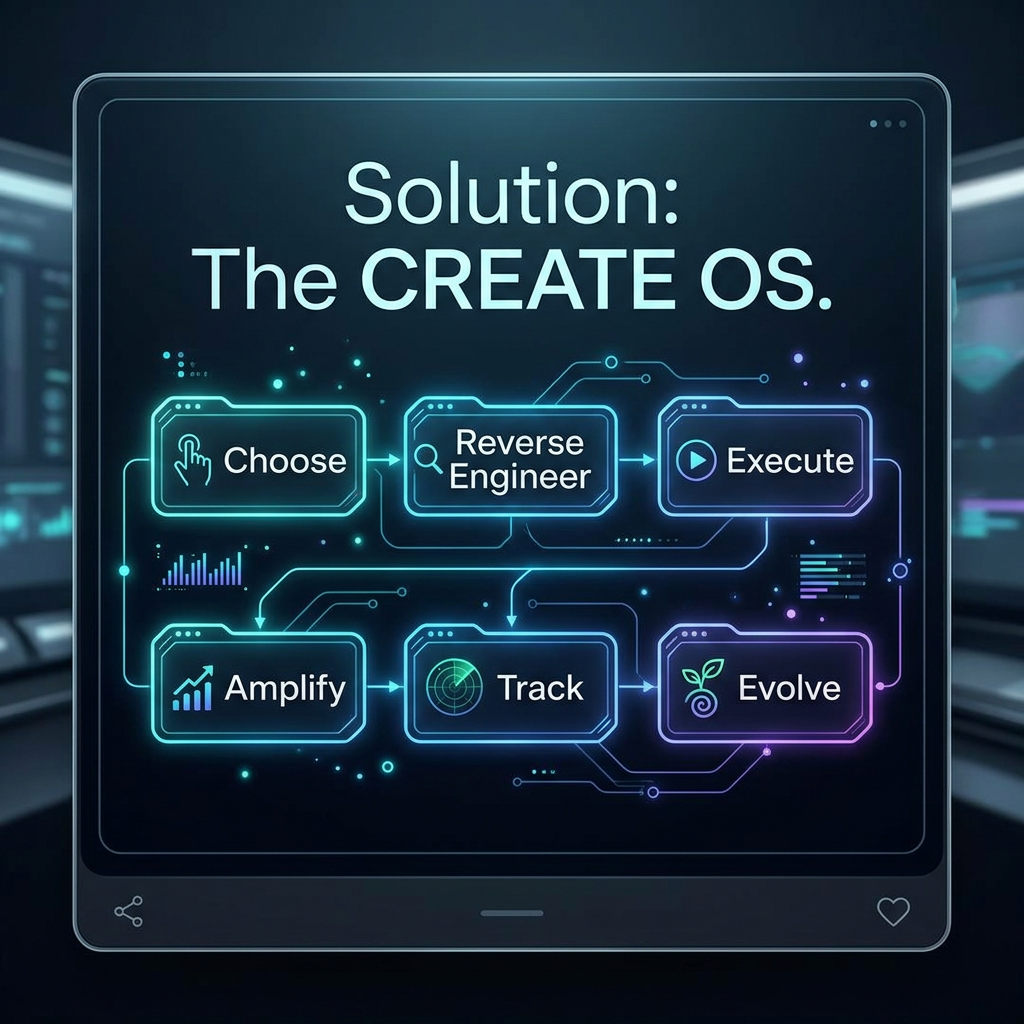
[C] Choose the work that matters.
[R] Reverse Engineer the path.
[E] Execute consistently.
[A] Amplify what you finish.
[T] Track what matters.
[E] Evolve every week.
The framework matters. It gives creative energy direction. But the heartbeat of CREATE is accountability.
Weekly accountability gives independent creatives a place to declare their Primary Quest, reaffirm their completion date, work with intention, overcome resistance, celebrate progress, and keep moving when life gets in the way. It helps prevent creators from drifting from idea to idea. It helps them finish work that deserves to exist. It helps them share that work with the people who may need it.
Independent Creatives are already full of ideas. They're clearly capable of an endless reservoir of inspiration and ideas. They're constantly working on meaningful ideas.
The next level is building continuity, structure, commitment, and accountability to bring the right ideas into the world at the right time.
Inspiration ignites the fire. Accountability keeps it burning.
When independent creatives are supported long enough to focus, finish, share, and grow, their work has a much better chance of reaching the people it was always meant to serve.