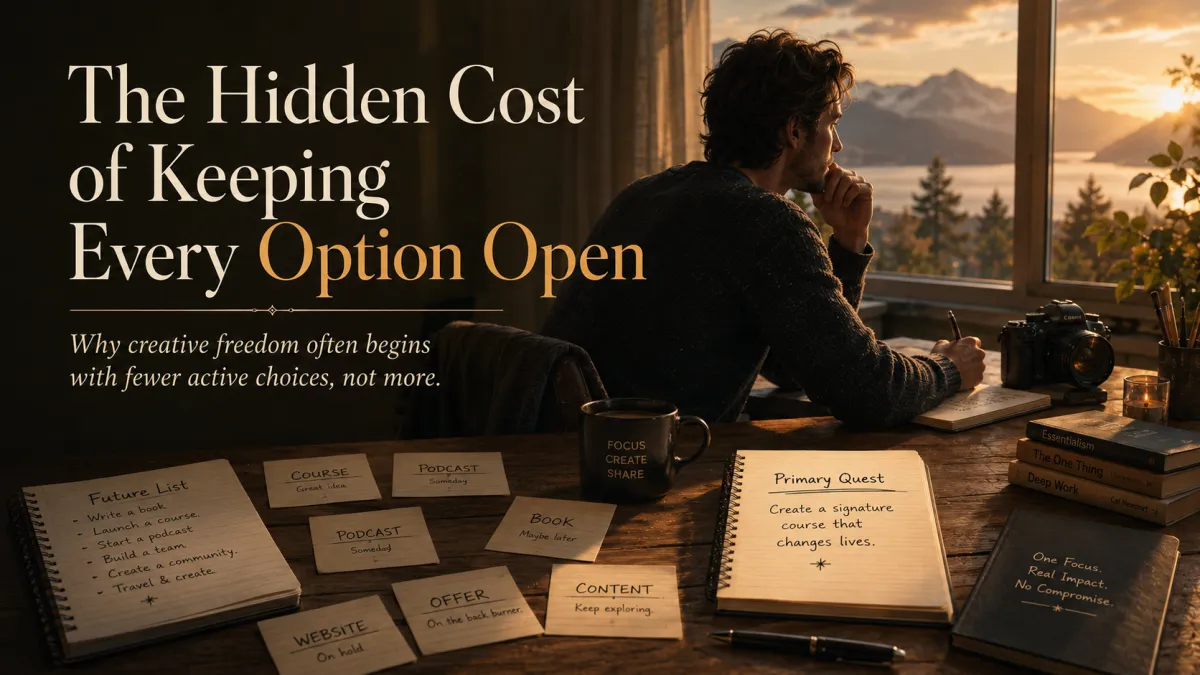
The Hidden Cost of Keeping Every Option Open
Why creative freedom often begins with fewer active choices, not more.
Creative people often feel stuck because they have too many ideas, not enough time, and no reliable way to sort those ideas into a clear order of importance.
The result is a creative life filled with open, scattered creative energy.
A book idea that is still waiting to be started.
A course idea that won't go away.
An exciting new podcast now feels urgent.
A website that needs rebuilding.
A social media strategy needs to be established.
An emotional attachment to a half-finished project.
Each idea may be good. Some may even be excellent. But when too many ideas remain active at the same time, they begin competing for the same limited resources: attention, time, energy, confidence, money, and emotional bandwidth.
That competition has a cost.
The inability or unwillingness to make decisions. Every day begins with too many possible directions. You sit down to work and have to decide, again and again, which project deserves your attention.
This results in an endless supply of unfinished work. You begin to make progress on one idea, then shift to another idea before the current project has a chance to be completed.
You constantly battle conflicting emotions. Even as you're busy working, part of your mind still lingers, carrying the heavy weight of all the remaining ideas and unfinished projects.
This constant shift in focus can cause confidence to diminish. The longer projects remain unfinished, the easier it becomes to be discouraged and feel like you can't accomplish your goals and dreams.
The real issue is that you're trying to hold on to too many active possibilities at once.
The Illusion of Freedom
I know from personal experience the feeling of obligation to keep all ideas open and available. It keeps you feeling flexible and creative. It feels like you're honoring all your ideas and protecting yourself from choosing the wrong thing. Pivoting becomes easy.
But open options continue to consume energy. Every unchosen idea keeps whispering. Each idea is trying desperately to get your attention. Unfinished projects keep pulling. Each idea is sabotaging the work you are actually doing today.
When nothing has been clearly chosen, everything remains emotionally available, creating the illusion of freedom while simultaneously producing pressure. Real creative freedom begins with fewer active choices, not more.
There is tremendous emotional relief in saying, “This is the ONE project I am focused on right now.” There is strength in deciding, “This is my priority, my focus for the next 90 days.” It's mentally and emotionally freeing to admit: “These other ideas matter and are important, but they're not what I choose to work on for the time being.”
Choosing gives your creative energy focus.
The Opportunity Cost of Scattered Attention
Every choice has a cost.
Choosing to work on only one project means you are temporarily choosing not to work on others. That can feel very unsettling. It can cause anxiety, especially for independent creatives with wide interests and a never-ending stream of ideas.
But failing to choose has a cost too. The cost of failing to choose is diluted effort.
You spend a little time here, a little time there, and maybe a little time somewhere else. You stay busy. You make limited progress. You feel like you're working hard because you are. But scattered effort rarely compounds.
A project needs sustained attention and effort long enough to gather momentum. It needs repeated contact. It needs a logical sequence of decisions. It needs the benefit of your prime thinking over an extended period of time.
When you divide your energy across five or ten active projects, each one receives a fraction of what it needs. You may be working constantly, but very little gets finished, shipped, published, launched, released, or improved.
That is the opportunity cost of keeping every option open.
When you keep all the possibilities available, you prevent one possibility from becoming real, complete. However, the benefit of choosing one thing is focus. The cost of failing to choose one thing is prolonged fragmentation.
One cost leads to completion. The other leads to an extended period of time of almost. I almost got it done.
Choose One Active Priority
The solution is to prioritize your ideas. The solution is to separate your current work from your future work.
An active priority is the ONE project, goal, or task that receives your focused creative attention for a defined season. For some projects, that time frame may be 30 to 60 days. A website rebuild, a lead magnet, a short course, or a simple launch campaign may not need longer than two months.
For larger projects, 90 to 180 days is often a strong working range. It's long enough to make meaningful progress and short enough to create urgency.
For major creative work, the time frame may be much longer. A 200,000-word novel, a large body of music, or a major business build may require a year or more. But even then, the work needs to be broken into milestones that don't stretch endlessly into the future.
A long project needs manageable milestones. Six months is a useful maximum for major milestones because it forces focus and clarity. You need to ask: “What part of this larger work needs to be completed in this 6-month time frame?”
Creative progress then becomes manageable. You're not choosing for the rest of your life. You're choosing the work that deserves your time and attention during this finite period of time.
Protect Your Other Ideas
Creatives often resist choosing a project because they believe choosing one idea means betraying the others. That is an erroneous belief that results in unnecessary pressure.
You don't abandon your other ideas. They still need to be captured, protected, and preserved for future attention.
This is where a Future List becomes powerful. The Future List is an independent creative's superpower. A Future List is a dedicated place for all the ideas you have that aren't a current priority. Any idea that is not part of the project you're working on needs to be transferred to the Future List.
The Future List can be a document, notebook, spreadsheet, project board, or notes app. The format matters less than the function.
The function is simple: Your ideas need somewhere to go so they stop interrupting the work you've already chosen. When a new idea appears, write it down. Give it a short description. Add any important notes while the energy is fresh. Then forget about it and return to the current priority.
This one single practice can change the way you work. Your ideas are no longer lost, rejected, forgotten, or in competition with your current priority project. They've been placed in a trusted location for future evaluation. This evaluation occurs when your current project is finished, and it's time to choose another primary project.
You'll be surprised at the amount of emotional baggage that is removed. Instead of carrying five or ten active projects in your head, you carry only one active priority and a protected list of future possibilities. Your mind settles and becomes clearer. It's easier to focus. Your next action becomes easily identifiable.
The Confidence That Comes From Completion
Creative confidence comes from making commitments and keeping them, not from having unlimited options. Every completed project changes the way you see yourself. Every finished article, released album, published video, launched offer, completed website, or live course gives you evidence that you're on your way to fulfilling your creative goals.
Why do you need evidence? Each piece of evidence demonstrates that you're capable of following through. It shows you that your ideas can become real. You learn that you can begin, survive the difficult middle, complete a project, and share your completed project with the world.
That kind of confidence is impossible to build when attempting to work on every project, every idea simultaneously. Unfinished work creates doubt. Completed work creates certainty, evidence.
The more you finish, the more freedom you gain. Once one priority is completed, you're free to choose the next one. You can return to your Future List with excitement, confidence, and more capacity.
Summary: Choosing one thing doesn't limit your creative life. It creates the conditions that allow more of your creative life to become real over time. Unfortunately, this is the part many, many creatives miss and never understand.
A Goal for This Week
Write down every active idea, task, project, offer, content plan, creative goal, and unfinished possibility currently taking up space in your mind. Then divide the list into two categories: 1) Active Priority, 2) Future List
Only ONE item belongs in Active Priority. Everything else goes on the Future List.
Then define the time frame. For the next 30, 60, 90, or 180 days, what will receive your focused attention? What project deserves your time, resources, and emotional energy most right now?
What would become possible if you stopped exploring every option and gave one important priority the consistency it needs? Don't worry, you don't need to solve your entire creative life this week. But...you do need to choose the work for this immediate time frame.
Final Thought
Keeping every option open feels safe until you recognize how much it is costing you.
It costs focus.
It costs energy.
It costs confidence.
It costs momentum.
It costs completion.
It costs money.
It costs time.
Choosing one active priority requires courage because it asks you to take responsibility for the direction of your creative work.
But that responsibility is also empowering. You're free to choose. You're free to focus. Your other ideas become protected on your Future List. You're finally able to finish one meaningful project before moving on to your next project.
This is real creative freedom, and it begins when you finally close a few doors, protect what belongs in the future, and give one important project the dignity of your full attention.
Choose what matters. Do the work. Build Momentum.