The Power of No: Why Every Meaningful "Yes" Requires Protection
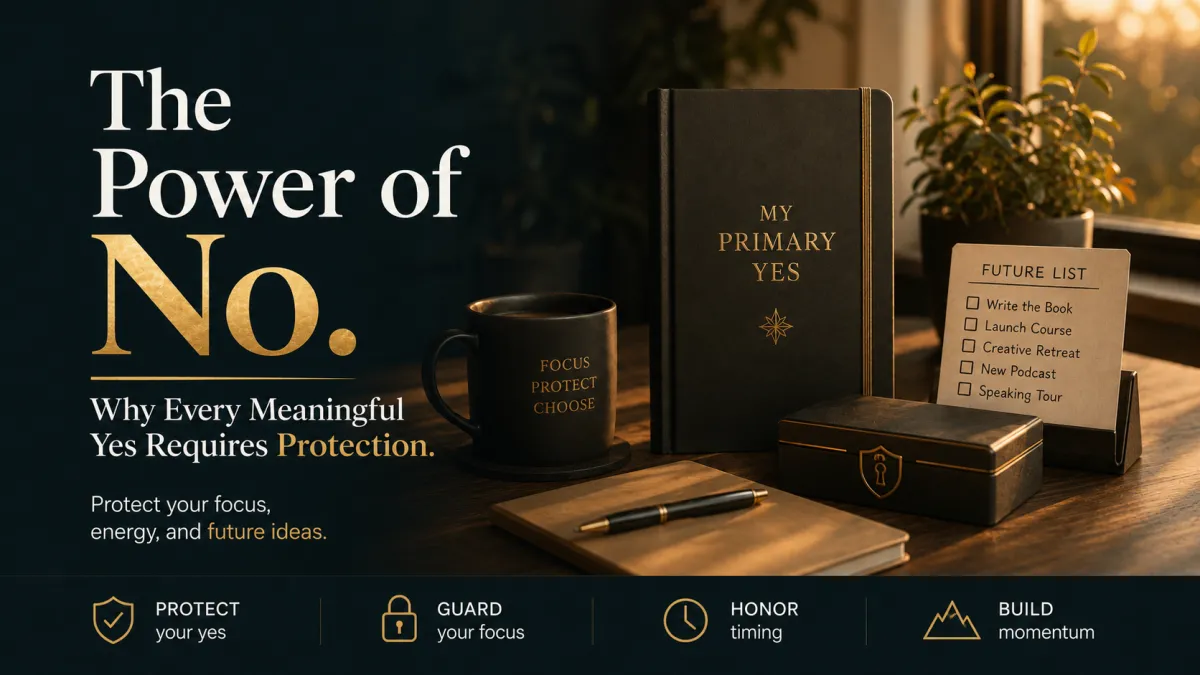
Every meaningful "Yes" needs protection.
A creative "Yes" isn't small. When you say "Yes" to writing a new book, designing a new course, recording a new podcast, starting a new business, or working on any new project, you're not merely adding another task to your calendar. You're giving part of your life to something that matters. You're offering your time, attention, imagination, energy, resources, emotion, discipline, and follow-through. You're deciding that one idea deserves enough focus and commitment to become real.
That kind of "Yes" can't survive if it's constantly distracted by every other idea that's allowed to enter and remain in your mind whenever it wants.
This is where the power of "No" begins.
"No" is a word that is frequently misunderstood. Many creatives hear the word "No" and immediately begin to panic. It sounds like rejection. It sounds harsh. It sounds limiting. It presents itself as the opposite of creativity, openness, generosity, possibility, and expansion. For a person who can and does see ideas everywhere, "No" can feel like a door slamming shut on something potentially beautiful.
I acknowledge that the feeling of rejection or the perception of closing the door on something potentially amazing is real. But those feelings create the wrong way to look at "No." Why is saying "No" so incredibly important? What is the purpose of "No?"
The purpose and power of "No" is protection.
"No" protects the "Yes" you've already chosen. "No" protects the project that you're currently working on, which is demanding and deserves your complete attention. "No" protects all your future ideas by placing them somewhere safe until their turn for attention and priority arrives. "No" protects your emotional energy from being scattered across too many unfinished possibilities.
"No" isn't the death of possibility, but rather, it's the boundary that allows possibility to mature.
For many years, I didn't really understand this. I used to say "Yes" to many ideas that should have been told "No". I thought saying "No" to a new idea meant I was dishonoring it and ultimately killing it. It never occurred to me that the new idea could be amazing and be saved for a later time. I didn't know how to acknowledge a good idea and then put it aside for evaluation at a future date.
One day, several years ago, my wife Angie told me something that changed the way I thought about my creative work. She told me I needed to start saying "No" to potential projects and focus my time and attention on one major project at a time.
At the time, she probably didn't realize she was preaching what I now call the Power of ONE. But that's exactly what she was doing. She was pointing me toward the first step of CREATE before CREATE became the framework it is now. The "C" in CREATE stands for CHOOSE. Choose one thing – only one thing. Focus all your attention on one project. Let all other ideas wait.
Something amazing and unexpected happened. It felt so good to say "No." That took me by complete surprise. It felt so freeing. I expected others to get mad when I told them I couldn't collaborate on a new project right now. People understood. I learned that it was okay to say "No".
Just because I'm focusing on ONE big project at a time doesn't mean I don't still get asked to collaborate with others, or that I stop getting new ideas, because I do. As I've written about in the past, one of the greatest gifts creatives have is looking at the world in such a way that new ideas constantly flood their mind.
What do we do with all these ideas? I had to learn to say "No." You will have to learn to say "No" to lots of brilliant ideas. I began to understand that these ideas needed to be placed somewhere that allowed me to free up emotional energy and preserve mental focus. These ideas need protection.
That is what the Future List provides.
The Future List gives you a place to put all your new ideas so your mind can release those ideas without losing them. You're free and able to acknowledge, “This idea matters, but not right now.” It lets you protect ideas until they are ready to be evaluated, and one of those Future List ideas is chosen to become your next priority.
Going through this process honors both your current idea, ideas that are patiently waiting their turn, and ultimately the idea that becomes your next Primary Quest.
Once a creative experiences that shift, the word "No" becomes something entirely different. "No" becomes liberating. Your entire creative world begins to change.
Creatives Are Trained to Stay Open to New Ideas
Creative people are often extremely open to receiving ideas. They're open to inspiration, open to people, open to possibility, open to patterns, open to beauty, open to problems that need solving, open to new ways of seeing the world. That openness is part of the creative gift.
A creative person can hear a phrase in a conversation and imagine a song, a chapter or character in a book, a brand, a workshop, or a performance. They can watch someone struggle and imagine a way to help them. They can see a gap in the marketplace and imagine a new offer. They can notice a recurring frustration and imagine a podcast series, a keynote, a course, or a community. Creatives aren't simply consuming the world around them. They're constantly interpreting it, reshaping it, and asking what else it could become.
While that openness is powerful, it's also extremely vulnerable to overload.
Because when you're open to everything, everything can start asking for access and time. Each idea wants attention. Each new opportunity feels important. Every request can feel connected to something bigger. Every new platform, strategy, collaboration, trend, or creative spark can appear at exactly the moment you're trying to stay focused on something else.
Frequently, creatives stay open to new ideas and possibilities because they don't want to miss out on anything. They want to remain flexible and available. They don't want to ignore a potentially great idea. This results in the creative keeping every door open because they don't want to choose the wrong thing and regret what they left behind.
That desire is completely understandable. However, openness without discernment and discipline leads to focus fragmentation.
A wide-open creative life can become a house with every window and door open at the same time. Fresh air comes in, but so does noise. So do distractions. So do interruptions. So does that constant, nagging feeling that something else might be more important than the work in front of you.
Discernment allows the creative person to remain imaginative without becoming scattered. It allows ideas to be welcomed, captured, and protected without being granted immediate priority. Discipline allows a person to say, “I see the possibility here. I'll put it on my Future List,” and remain loyal to their current Primary Quest.
That is how "No" becomes so powerful. "No" becomes a strategic gatekeeper.
"No" Is Protection
The most important shift is this: "No" protects. It doesn't reject. "No" protects your current Primary Quest.
It's important to establish boundaries for your Primary Quest. Your quest requires dedicated time that is scheduled on your calendar. It needs enough space in your mind and enough emotional energy to survive the hard, messy middle. A Primary Quest doesn't remain primary if every new idea competes with it the moment the new idea appears.
"No" protects that priority. It keeps all focus, time, and attention on the current project, allowing you to continue working on your priority until it's complete. Every Primary Quest has a Focus Anchor date. The hard deadline for Primary Quest completion. Until your current project is complete, all your other great ideas remain safely protected on your Future List.
The protection the Future List offers is something that creatives often miss. They fail to realize that when a new idea shows up and they place it on the Future List, they are actually honoring their new idea, not dismissing it. They're giving it a safe place to live and to wait until it can become the new priority.
Many good ideas are weakened or die because they're started too soon. They receive time and attention at a moment when the creator doesn't have the time, energy, structure, audience, or resources to execute properly. The idea barely gets started. It receives enough resources and attention to create emotional attachment, but not enough time and attention to become a realized, completed work. Predictably, it joins the growing pile of unfinished, unrealized work, and now, what once felt exciting, carries stress.
Proper utilization of the Future List protects those ideas from that undesired fate. Not only does the Future List protect all your amazing ideas, but it also protects your emotional energy. That's so important. Every idea actively consumes energy. Even when you're not working on it. By placing non-Primary Quest ideas on your Future List, those ideas don't remain active in your head, resulting in freed-up emotional energy.
The Future List, when utilized correctly, provides the emotional freedom you need to be able to focus on your current project.
The Most Dangerous Opportunities Are Often Good Ones
The hardest "No" is rarely the "No" to something obviously wrong. It's pretty easy for creatives to say "No" to ideas that don't matter or opportunities that aren't in alignment.
The hard "No" is the one that is the "No" to something good. Great ideas can arrive at the wrong time. Good opportunities can create fragmentation. A good collaboration will still pull energy away from your Primary Quest. Beginning work on a new project before your current work has matured can, and most likely will, drain you and confuse your audience.
This is where creative entrepreneurs need discernment and discipline. The question can't be, “Is this good?” Many ideas are good, interesting, and potentially very valuable.
The better question is, “Does this idea contribute to my current Primary Quest?” If the idea or opportunity doesn't contribute to your current objective, it belongs on your Future List, especially if the idea is a great opportunity. The opportunity can have real potential and still become Shiny Object Interference for today.
Urgency Makes "No" Harder
Urgency can make an idea feel like the right idea. It can create doubt in your decision to continue working on your current objective. It can create pressure that feels like clarity. It can convince you that if you don't act immediately, you'll miss the moment.
Urgency has a way of making "No" feel irresponsible or even impossible.
A new idea appears, and suddenly it seems like action is required immediately. Then someone mentions a trend, and all of a sudden your current work feels outdated or maybe even unnecessary. A person invites you into something exciting, enticing, possibly even life-changing, and suddenly saying "No" feels like missing your chance.
This is why urgency is so dangerous. Relying on urgency alone is a poor way to make decisions. Sometimes urgency is real. Sometimes deadlines do matter. But urgency can also be novelty in disguise. It can also manifest as fear. It can be avoidance. It can be all the discomfort of the hard, messy middle tempting you to disregard your current project and lure you toward something easier, rather than buckling down, getting to work, and finishing what you've already spent time, resources, and energy on.
"No" gives you time to pause and evaluate. It allows you to ask whether the idea belongs now or later. It allows you to separate urgency and intensity from what is important today. It allows you to protect the Primary Quest from being overthrown by every urgent possibility.
This is why having and using a Future List is so important. Without it, saying "No" to a good idea can feel overwhelming. It can feel like loss. With it, saying "No" becomes a simple matter of sequencing and prioritizing. That knowledge is liberating.
The Future List Makes "No" Safer
The Future List is what makes "No" emotionally safe for creatives. Without a Future List, creatives may fear that ideas that aren't immediately acted upon will be forgotten and lost. To avoid forgetting and losing, you may try to hold new ideas in your mind. You may create a note and place it "somewhere" for safekeeping. You may start the idea just to keep it alive.
All these actions interrupt your current priority. What was just an idea has become a new project that was never intentionally chosen. The Future List changes that pattern.
It gives you a safe and secure place to capture all new ideas. It then allows the mind to release the idea because it's been preserved. It removes the fear that focus will cause you to forget something important.
The Future List isn't just a planning tool. It's also an emotional tool. It keeps attention and focus on the current Primary Quest. Knowing your ideas are protected and your focus remains on the task at hand is so emotionally freeing. Your ability to say "No." gets easier and is used with more frequency and efficiency.
"No" Creates Better Work
Great creative work requires much more than a burst of inspiration. It requires sustained focus, energy, and attention. It needs time to develop. It needs revision and testing. It needs refinement.
A project that receives fragmented attention often remains underdeveloped. It may have a strong initial spark, but it never gets the depth it needs. The project may never get finished, and if it does, it can confuse the audience and lack the quality your audience demands.
"No" changes that. "No" improves the quality of work because it protects focus, time, and attention.
When you say "No" to the ideas that do not belong right now, your current work gets more of you. It gets your full imagination, time, and resources. It gets your best thinking. It gets your commitment to continue working past the exciting beginning, when it becomes hard. It gets the benefit of repetition, feedback, and revision. It gets the chance to become something bigger and better than you originally imagined.
Your focus becomes fine craftsmanship. Your book becomes better. Your album becomes stronger. A podcaster becomes a better conversationalist. You become a better business owner. Everyone benefits: you, your product, and the people your product serves.
A protected "Yes" creates a better and clearer signal. A clearer signal encourages people to follow, trust, and eventually buy from you. A better product. A better audience. A better you.
The Freedom of a Protected "Yes"
There is a kind of freedom that you experience only after you CHOOSE. As we've talked about in the past, choosing ONE thing and saying "No" to everything else can feel very uncomfortable. Even with a completed Future List, a new opportunity may still feel tempting.
Old habits may persist for a while. You know how to protect both your current Primary Quest and this new idea by transferring it to your Future List. Over time, you wake up with less to negotiate. Less to worry about, and then relief begins. When a new idea arrives full of energy, you know what to do.
With continued practice, you stop apologizing to every idea that hasn't yet been chosen. Your current project no longer fights for attention with potential future ones. Your mind is no longer trying to carry every possibility at the same time. Your focus improves. Your current work improves because you permit it to receive your full attention. Finishing feels possible.
This is why saying "No" can feel so surprisingly good. You learn that "No" isn't a limitation. It's freedom. It's a mental and emotional release.
This is the freedom of a protected "Yes." It's the freedom to let good ideas wait. It's the freedom to focus on your current project.
The power of "No" is not negative. It's freedom. It's discipline. It's how you protect your current and future work.
It's how you honor your Primary Quest and your Future List at the same time.
Every meaningful "Yes" requires protection. That protection is "No".
And once you experience how freeing that can be, you begin to understand that "No" is not the enemy of your creativity. "No" may be one of the most important gifts you can offer your creativity.
Choose what matters. Do the work. Build momentum.
If this is the kind of structure and accountability you need in your creative life, I invite you to register for the next free CREATE training and learn how the CREATE OS can help you focus, finish, and grow.