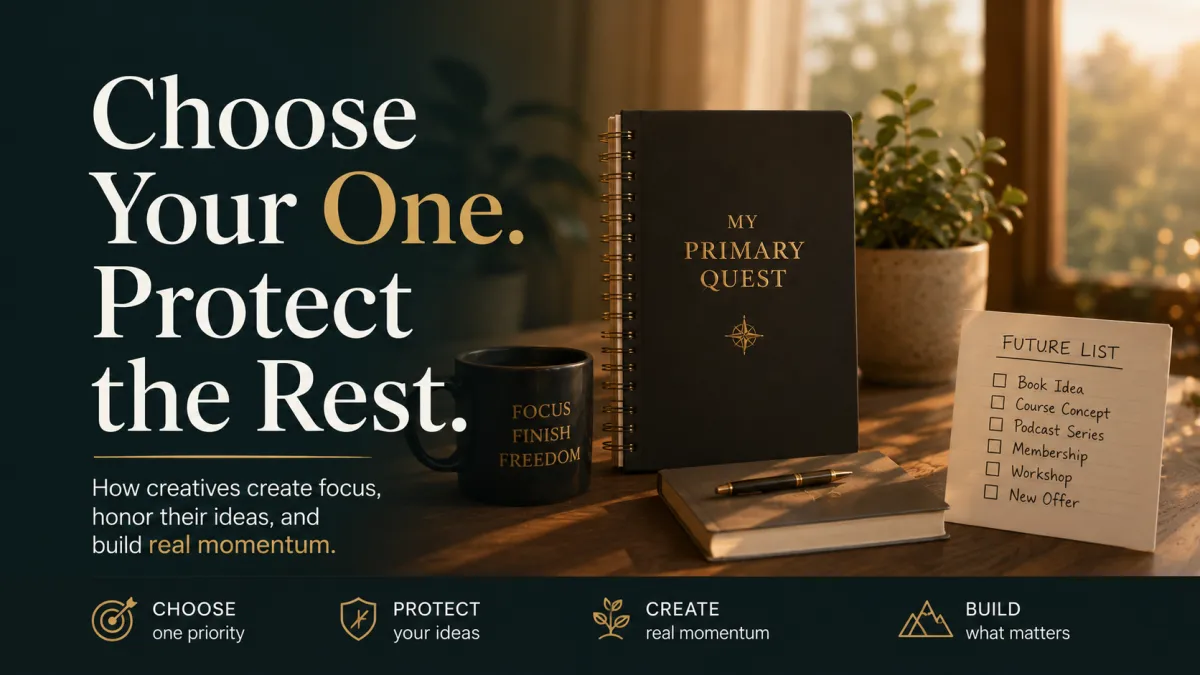
The Power of One Priority: How the Future List Helps You Focus, Finish, and Protect Your Best Ideas
Creative momentum begins when one idea is allowed to become more important than the others.
That sounds simple, but for many independent creatives, it can feel almost impossible. Creatives often have an endless supply of ideas. Many are supremely talented. Many are multi-talented across artistic, musical, literary, educational, entrepreneurial, and expressive forms. They can write, teach, compose, design, speak, coach, perform, paint, imagine, and connect ideas that other people would never think to connect. That's one of the reasons their problems become so complicated. The same mind that can see possibilities everywhere can also struggle to decide which idea or possibility deserves its full attention right now.
This is one of the greatest gifts of the creative mind. A conversation can become an idea for a podcast. A client's problem can become an idea for a course. A personal breakthrough can become an idea for a book. A musical phrase can become a full composition. A teaching frustration can become an entirely new teaching method. A passing thought can become a business, a workshop, a community, a body of work, or a new direction. Creatives do not merely observe the world as it is. They see what it could become. They look at raw material and imagine form. They look at limitations and imagine possibilities. They look at what already exists and ask, “What else could this be?”
What an extraordinary ability. An ability like that demands attention. When you can see possibilities almost anywhere, every idea can begin to feel important. Every project can feel meaningful. Every direction can feel urgent. Every new spark can appear to be the one that must be acted on immediately. The creative person doesn't deal with a shortage of inspiration. They are filled with idea abundance. The challenge is learning how to organize that abundance so it can become finished, useful, and visible work, and meaningful, lasting momentum.
This is why the discipline of choosing one thing matters so much.
Choosing one thing isn't the rejection of your creative range. It's the decision to give one meaningful idea enough attention, time, energy, and structure to become real.
The Gift of Seeing Possibilities
One of the saddest things I've heard from many piano teachers over the years is a version of this sentence: “If I can’t see it, I can’t play it.”
On the surface, that may sound practical. It may even sound disciplined. But it also reveals a limiting view of creativity. It suggests that what already exists is the boundary of what is possible. It keeps the mind locked inside what can currently be seen, touched, tasted, heard, measured, or repeated. That way of thinking can become especially limiting in traditional pedagogy, where methods, rules, and inherited patterns sometimes replace imagination, exploration, and innovation.
The more expansive creative mind works differently. It doesn't wait for everything to be visible before it begins to imagine. It sees beyond the current page, the current method, the current offer, the current business model, the current platform, or the current version of the work. A piano teacher who composes, experiments, and innovates gives students a completely different example. That teacher isn't merely passing down information. That teacher is modeling freedom. They're showing students that music, art, writing, business, and creative work are living things. They're showing that the world can be shaped, interpreted, expanded, and reimagined.
What an amazing, fabulous gift. But amazing, fabulous gifts still need stewardship.
The ability to see new possibilities everywhere quickly becomes overwhelming when every possibility is allowed to become active at the same time. A creative person may have a book idea, a course idea, a podcast idea, a teaching method, a membership idea, a video series, a workshop, a new offer, a website rebuild, a social content plan, and a half-finished project from six months ago all asking for attention – right now. Every one of those ideas may have value. Every idea may connect to something meaningful. And each one may deserve to exist someday.
Therefore, the problem isn't the presence of too many ideas. The problem is the absence of idea hierarchy.
Creatives Need Hierarchy, Not Less Creativity
A creative life doesn't become more powerful by shrinking the imagination. It becomes more powerful by giving the imagination structure.
Hierarchy is what allows creative abundance to become creative momentum. Without hierarchy, every idea has equal access to your attention. Your new book gets a little attention. Your course gets a little attention. Your website gets a little attention. Your podcast gets a little attention. Your offer gets a little attention. Your new platform gets a little attention. Even your old project gets a little attention. You stay constantly busy. You remain active. You continue thinking, planning, tinkering, revising, and exploring.
But very little, if anything, compounds.
That's the painful part. A creative person can be working hard and still feel like nothing is truly moving. They can spend hours every day inside their creative business and still feel as though they are starting over every few weeks, which is frequently true. They are, in reality, starting over every few weeks as they quickly transition from idea to idea. They can have genuine passion, real talent, and sincere commitment, yet still feel stuck in an endless loop of partial progress.
This results in System Fragmentation.
System Fragmentation happens when your projects, platforms, ideas, offers, habits, tools, and attention are spread across too many disconnected directions. In addition to becoming a productivity problem, it becomes an emotional problem. Every unfinished idea starts to carry weight. Every open loop asks for energy. Every possible direction creates a small background question: “Should I be working on that instead?” And that question kills momentum.
This is what CREATE is designed to change. The goal isn't to make creatives less creative. The goal is to help creatives prioritize, focus, finish, and grow. The goal is to create a system that can hold their abundance without allowing that abundance to become daily confusion. The goal is to help a creative person choose a Primary Quest, protect the rest of their ideas on a Future List, and build enough structure around the current priority to make finishing inevitable.
That is the power of ONE.
Choosing Feels Like Loss Until You Understand What It Really Is
Asking a creative person to put an idea on the back burner can feel almost cruel at first.
A true creative doesn't experience ideas as random tasks. Ideas often feel alive. They feel connected to identity, purpose, service, expression, income, freedom, contribution, and possibility. When someone says, “Just choose one,” the creative person may hear, “Let the rest die.” That's why choosing can feel like a loss. It can feel like betrayal. It can feel like abandoning part of yourself.
Choosing one thing doesn't mean the other ideas are bad or unimportant. Choosing one thing means the current idea is being honored with the attention it needs. It means this idea is no longer being forced to compete with every other possibility in your imagination. It means the work in front of you gets the dignity of focus. It gets the chance to be planned, developed, revised, tested, improved, shared, and finished.
All the other ideas are honored and protected by transferring them to your Future List. Many creatives can't understand and won't appreciate the power of the Future List until they experience it. When you choose a Primary Quest and move all other ideas to a Future List, you're not disrespecting the other ideas. You're protecting them until it's their turn to become the priority. You're saying, “This matters, but it doesn't belong in my active work during this current time frame.” You're creating a place where the idea can remain safe without constantly interrupting your work that needs to be done now.
The moment a creative truly understands this, the emotional pressure will begin to change. It's so liberating. They realize that they no longer have to carry and support every idea in active memory. They discover they no longer have to worry about forgetting a good idea if they stop thinking about it every day. They no longer have to keep fifteen mental tabs open just to prove that nothing is being forgotten. The Future List becomes a trusted container. It holds the ideas. It preserves the context. It protects the future.
And the mind can finally breathe.
The Future List Isn't a Graveyard
A Future List is one of the most powerful tools a creative person can use, but only if it's understood and used correctly.
A Future List isn't a "junk drawer" for unwanted ideas. It's not a graveyard. Ideas don't go to the Future List to die. The Future List is a protected space for ideas that matter but aren't for right now.
When you don't have a Future List, every idea has to fight for survival inside your mind. You constantly have to revisit each idea because you're afraid of losing one. You create scattered notes and place them in random places. You begin documents that you never finish. You start outlines that are never developed. You bookmark tools that you never end up using. You create offers that never launch. You begin projects with just enough energy to become emotionally attached to them but not enough structure to complete them.
Over time, those unfinished ideas cause you to needlessly carry the stress of not having completed those ideas.
The Future List removes that stress by giving all your ideas a home. It allows you to capture the idea, preserve why it matters, and make an intentional decision that it's not your active priority right now. A strong Future List can include the idea, whom it might serve, what problem it might solve, what project it connects to, and why it's not for right now.
That turns the Future List into a strategic asset.
It becomes a living map of possibility. It allows the creative person to continue seeing, dreaming, imagining, and innovating without letting every new possibility, every new idea hijack their current work.
This is why my friend, Gregg, embracing the Future List matters so much. Once a creative or entrepreneur understands the power of it, they begin to feel the relief almost immediately. The Future List gives them permission to say, “Yes, this matters,” without also saying, “I must act on this today.” That is a life-changing distinction.
Urgency Isn't the Same as Priority
One of the biggest mistakes creatives make when choosing a Primary Quest is allowing urgency to make the decision.
Urgency is seductive. It feels clear. It creates pressure. It demands action. It often shows up with a deadline, an emotional charge, a new opportunity, a trend, a platform change, a client request, or a sudden fear of missing out. Because urgency feels intense, it can easily disguise itself as immediate importance.
But urgency often leads directly to Shiny Object Interference.
The biggest, boldest idea isn't always the most important idea. In fact, it's rarely the most important idea. The newest idea most often doesn't become the priority right now. The idea with the most emotional impact is seldom the idea that deserves attention during this Time Frame. Sometimes urgency is just novelty disguised as importance. Sometimes it's avoidance. Sometimes it's fear. Sometimes it's the discomfort of staying with the current project through the ugly, messy middle.
A Primary Quest should be chosen with more wisdom and care than urgency alone can provide. Which idea aligns best with your long-term goals? Which project would create the most meaningful momentum today if finished? Which priority has the most leverage? Which idea would make future decisions easier? Which one serves the people you're trying to help? Which one are you willing to stay with after the excitement fades?
Urgency can be part of the deciding information, but it shouldn't be the only information or the dominant information. When urgency becomes the primary decision-maker, the creative person becomes vulnerable to constant interruption. A new idea appears, and suddenly the current work feels less important. A new platform trend appears, and the existing strategy feels outdated. A new possibility arrives, and the current Primary Quest begins to look too slow, too difficult, or too ordinary.
That is the Shiny Object Cycle. The discipline of choosing one thing interrupts that cycle.
Choosing One Thing Makes Finishing Possible
Finishing is difficult enough when you're working on a single idea or project. It becomes almost impossible if every idea remains active.
A creative project needs more than inspiration. It needs continuity. It needs daily decision-making. It needs revision. It needs emotional resilience. It needs a clear path through the hard, ugly, messy middle. It needs enough time to become more than an exciting beginning.
The beginning of a project often feels wonderful. The idea is still clean. It hasn't been tested. It hasn't required hard choices. It hasn't been shaped by feedback. It hasn't demanded marketing, editing, delivery, or follow-through. In the beginning, the project exists mostly as potential, and potential is intoxicating.
The middle is different.
The middle is where the work becomes real. The middle is where the creator has to decide what the project is and what it's not. The middle is where tradeoffs appear. The middle is where the first version disappoints you. The middle is where the timeline gets longer than expected. The middle is where the next idea begins to look more and more exciting than the one you've already chosen.
Many creatives begin to drift during the hard, ugly, messy middle. They don't necessarily quit. They just reassign their emotional energy to something new. They keep the old project open, but it no longer receives their best, undivided attention. Eventually, they're surrounded by unfinished work that once felt thrilling and now feels heavy.
Choosing one thing and then working only on one thing gives your current project the best chance to survive the hard, ugly, messy middle.
It allows the creative person to stay long enough to refine the work, improve the product, clarify the message, create visibility, receive feedback, and complete something that can actually serve people. It turns the creative gift into a finished contribution.
Focus Improves the Work
Choosing one thing does more than increase output. It improves quality.
When one priority receives sustained attention, the work deepens. The message sharpens. The product becomes clearer. The audience becomes easier to understand. The next step becomes more obvious. The creative begins to notice details that would have remained invisible inside continued fragmentation.
A course becomes better when it's not trying to serve five different audiences at once. A book becomes stronger when the premise is allowed to mature. A podcast becomes clearer when the conversation has a center. A business offer becomes easier to explain when it's shaped around a specific problem for a specific person. A community becomes more powerful when its purpose is repeated, embodied, and built over time.
Creative businesses need this kind of focus and clarity.
A creative may be able to see how all of their ideas relate and connect. Unfortunately, the audience usually cannot. The audience needs repetition. They need a recognizable promise. They need to understand who the work is for and why it matters.
The audience needs to see the creator stay with something long enough to trust it.
When the creator is constantly shifting direction, the audience feels that confusion. One week, the message is about one thing. The next week is about something else. Then a new offer appears. Then a different project takes priority. Then a relaunch begins. Then another idea interrupts. Internally, it may all feel connected. Externally, it can look and feel extremely scattered.
Choosing one thing gives the work a center. And once the work has a center, everything else can begin to organize around it.
The Power of One and the Protection of Many
The Power of One and the Future List belong together. The Power of One says choose one Primary Quest that will receive your time, focus, attention, and resources right now during this current project cycle. The Future List protects all your other ideas until it's their time to be the next priority.
One provides focus. The other gives safety. Together, they create the structure creatives need to focus without feeling trapped and dream without becoming scattered.
This is the heart of the discipline. Creative people can't stop having ideas, and they don't need to. But they do need a way to decide which idea leads now, today. They need a way to honor and preserve the rest. They need a way to finish their current project without betraying all their other brilliant ideas. That is what idea hierarchy provides:
Some ideas belong to now.
Some ideas belong to later.
Some ideas need more time.
Some ideas need to merge with other ideas.
Some ideas need to wait until a current project creates the audience, skill, revenue, or clarity that will make the future idea stronger.
This results in idea sequencing. And sequencing is one of the most mature forms of creative stewardship.
Choose the Current Work. Protect the Future Work.
The discipline of choosing one thing is ultimately an act of respect. You respect your current idea by giving it focus and attention. You respect your future ideas by giving them a safe place to wait. You respect your audience by becoming clearer and more consistent. You respect your creative energy by reducing fragmentation. Finally, you respect your long-term vision by refusing to let every urgent thought become a priority.
This is how creatives begin to prioritize, focus, finish, and grow.
The creative life doesn't need to be a battlefield of competing ideas. It can become a living system where ideas are captured, protected, chosen, developed, finished, and eventually released into the world.
That's the promise of the Primary Quest.
That's the power of the Future List.
That's the discipline of choosing ONE thing.
Creative momentum begins when one idea is allowed to lead.
The Relief of Saying No
One of the unexpected gifts of choosing one thing is the relief that follows.
At first, saying "No" can feel uncomfortable because creatives often experience every idea as important and time-sensitive. New ideas may feel exciting, urgent, and full of possibility. But once that idea is placed safely on the Future List, "No" begins to feel different. It becomes less like rejection and more like protection.
Relief and freedom are waiting on the other side of "No." It's hard to explain until you experience it for yourself.
This is such an important part of creative momentum that I’ll explore it more fully in next week’s article: The Power of No Why Every Meaningful Yes Requires Protection.