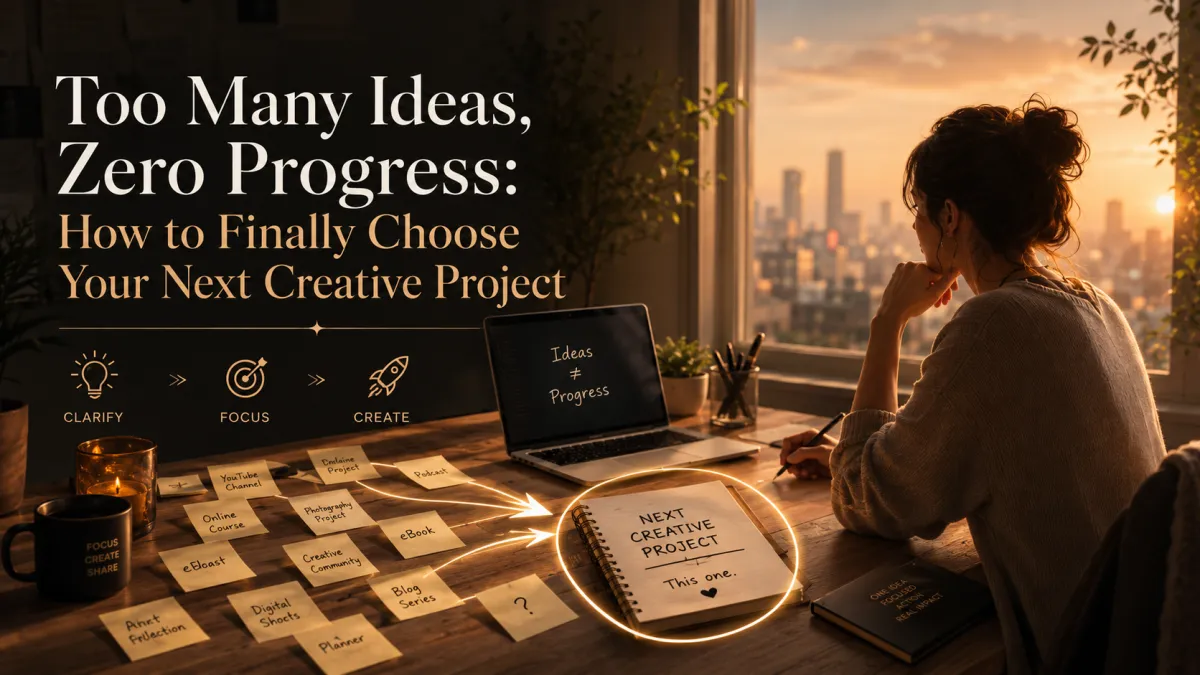
Too Many Ideas, Zero Progress: How to Finally Choose Your Next Creative Project
Part 1 of 4: The Creator's Path
One of the most common things I hear from independent creatives is this: "I have too many ideas. I don't know where to start."
It sounds like a good problem to have. And in one sense, it is. A limitless supply of ideas is a gift. Most creatives are wired this way. They see possibility everywhere. A conversation becomes a book. A morning walk becomes an album. A frustration becomes a course. A pattern becomes a business.
The real problem isn't the ideas.
The real problem is that having too many ideas and treating them all as equally important is functionally the same as having no direction at all.
When Everything Feels Important, Nothing Gets Done
Here's what happens when you refuse to choose:
You start writing the novel. Three days later, a new business idea grabs your attention. You pivot. A week into that, you revisit an old project you abandoned eight months ago. That one feels more urgent now. So you shift again.
Each new idea feels important. Each one carries a version of hope. But here's the truth: ideas feel most exciting when they're still being protected by imagination. They haven't been tested yet. They haven't been made real. And making something real is hard.
So instead of doing the hard work of finishing one thing, the mind drifts to the next idea. The next idea is full of potential. It hasn't failed yet. It hasn't shown you any of the resistance that the current project has already revealed.
When this consistently happens, you're not being rewarded with additional inspiration. You're avoiding doing the hard work and dressing it up with a little creative disguise.
The Difference Between a Good Idea and the Right Idea
Every idea you may have might genuinely be good. Some of them might even be great.
So how do you evaluate these ideas? You need to ask yourself: what is the right idea for right now?
This shifts everything. You're not ranking your ideas by permanent value. You're choosing which one deserves your best focus, your best hours, and your best effort for the next 90 to 180 days. Doing so reframes the entire conversation.
You're not abandoning the other ideas. You're putting them in their proper place: the Future List. A Future List is not a graveyard for discarded dreams. It's a protected holding space for ideas that deserve their own season. Just not this one.
This also solves the guilt many creatives carry about "leaving things behind." You're not leaving them behind. You're sequencing them. You're giving one idea the gift of your full attention while the others wait for their turn.
How to Choose Your Primary Quest
Inside the CREATE Operating System, the first step is [C] CHOOSE. Specifically, you choose one Primary Quest: one creative project that becomes the center of your time, focus, and resources for the next 90 – 180 days.
Here's how to identify it:
First, ask yourself: Which project has the highest urgency right now? Not urgency as in anxiety. Urgency as in real-world timing, personal readiness, or aligned momentum. Is there a book you keep promising yourself you'll write? A course idea that keeps circling back? A body of artwork that deserves to be finished and seen?
Second, ask: Which project, if completed, would have the most meaningful impact on my creative business or life? This separates strategic choices from quick impulse decisions.
Third, ask: Am I avoiding this project — or genuinely excited by it? Resistance to a specific project is often a signal, not a reason to abandon it. The projects that scare us a little are often the ones most worth doing.
Fourth, ask: Can I commit to this project for 90 – 180 days without changing course? That's the real test. Choosing a Primary Quest means agreeing not to let the next shiny idea pull you away, at least not until this project is complete.
What to Do With the Rest
Every idea that doesn't become your Primary Quest goes on the Future List.
Write it down. Give it a sentence or two. Let it live there.
Then close the door on it...for now.
That simple act, honoring the idea without chasing it, is one of the most powerful discipline moves a creative can make. It tells your brain: this isn't lost. It's just not now.
And it creates one of the most important conditions for creative progress: mental clarity.
When you're only focused on one Primary Quest, you stop bleeding energy across five half-started things. You stop carrying the weight of the unchosen. You move from scattered to aligned.
Why This Changes Everything
Creative progress isn't about having the best idea. It's about choosing one idea. Working it. Finishing it. Making it real.
The most prolific creatives aren't prolific because they work on everything at once. They're prolific because they work on one thing until it's done, then move to the next. One completed project builds the skills, the confidence, and the momentum for the next one.
Choosing is the beginning of the entire creative system. Everything else: execution, visibility, accountability, and growth depends on this first decision.
The Challenge
Write down every idea that's currently competing for your attention.
Now pick one.
That's your new Primary Quest for the next 90 – 180 days.
Congratulations! You've officially chosen your focus for the next three to six months.
A chosen idea with imperfect execution will always outperform a perfect idea that stays stuck in imagination.
Choose what matters. Do the work. Build momentum.
Next in the series: Why You Keep Starting Over: And How to Finally Finish What You Start